

Your Body Is Not a Problem to Solve
How the language of empowerment has turned women’s bodies into lifelong improvement projects

Last week I spoke at an International Women’s Day event in Sydney. The topic was female empowerment.
The room was full of women, all accomplished professionals. It was the sort of gathering where you might expect conversations about leadership, autonomy, and the many ways women are shaping the world.
But as the speakers progressed, it became clear that the “empowerment” being discussed had little to do with expression and everything to do with appearance.
The speaker following me, someone who had had so much cosmetic work done, and was so plastered with makeup that she looked like a living sex doll, talked about managing your appearance in order to feel confident.
And then, the most shocking of all: a medical doctor, someone who has pledged to “do no harm”, was encouraging body dysmorphia to the extent that she actually recommended “preventative Botox” for women in their twenties.
This concept is not only scientifically incorrect - Botox does not prevent wrinkles, so using it before you have wrinkles does nothing except lighten your bank balance - it also trains women to believe their bodies are damaged and in need of fixing.
As this horror unfolded, all I could think was:
How on earth did this become normal?
The Internalisation of Objectification
Not that long ago, one of the central critiques of patriarchy was the way women’s bodies were treated as objects. Women rightly objected to being reduced to how we looked; to being judged according to a narrow aesthetic ideal; to the idea that our bodies were commodities to be evaluated, improved, and displayed for approval.
Women are not objects and our bodies are not projects to be constantly corrected. And yet, sitting in that room last week, I had the unsettling sense that something had shifted.
The language has changed. The justification has changed. But the dynamic itself has not. Because what I was hearing that morning was not men objectifying women. There wasn’t a single man in the room.
It was women telling women that empowerment means managing your body as an ongoing project: monitoring it, correcting it, preventing its natural changes before they even occur.
In other words, we’ve internalised the objectification we once protested.
Adornment vs Correction
Now, let me be clear. There is nothing wrong with enjoying beauty, style, or even a little aesthetic enhancement.
Adornment is as old as humanity. Jewellery, clothing, cosmetics, tattoos — humans have always decorated their bodies. These things can be playful and creative.
The difference lies in the psychology behind it.
Adornment says: I like this. It’s fun. It adds something.
Correction says: There’s something wrong with me that needs fixing.
One comes from enjoyment. The other comes from self-criticism. And what struck me in that room was how completely the language of correction had been normalised.
The message wasn’t “If you enjoy it, go for it.” The message was: Start early, prevent flaws, stay ahead of the inevitable. In other words, treat your body as a problem to be managed before it even has the chance to misbehave.
Anxiety Dressed Up as Empowerment
This isn’t empowerment.
It’s anxiety dressed up as empowerment.
And it places women in an impossible position. Because when the body becomes a project, the work is never finished. There will always be another wrinkle to prevent, another feature to refine, another treatment promising to keep you just one step ahead of time itself.
And the result? Women scrutinising themselves endlessly, spending extraordinary amounts of money, and still feeling as though they are falling short.
That isn’t freedom. It’s simply a more sophisticated version of the same old trap.
The Sovereign Stage of Life
The deeper problem with treating the body as a project is that it places us in opposition to the most natural process of all: ageing.
The language alone reveals the mindset: “anti-ageing.” As if ageing itself were a failure. But the truth is simple:
You cannot not age.
If we’re lucky, we all move through the stages of life: our bodies change, skin loosens, lines appear, hair turns grey. These are not defects. They are signs of a life being lived.
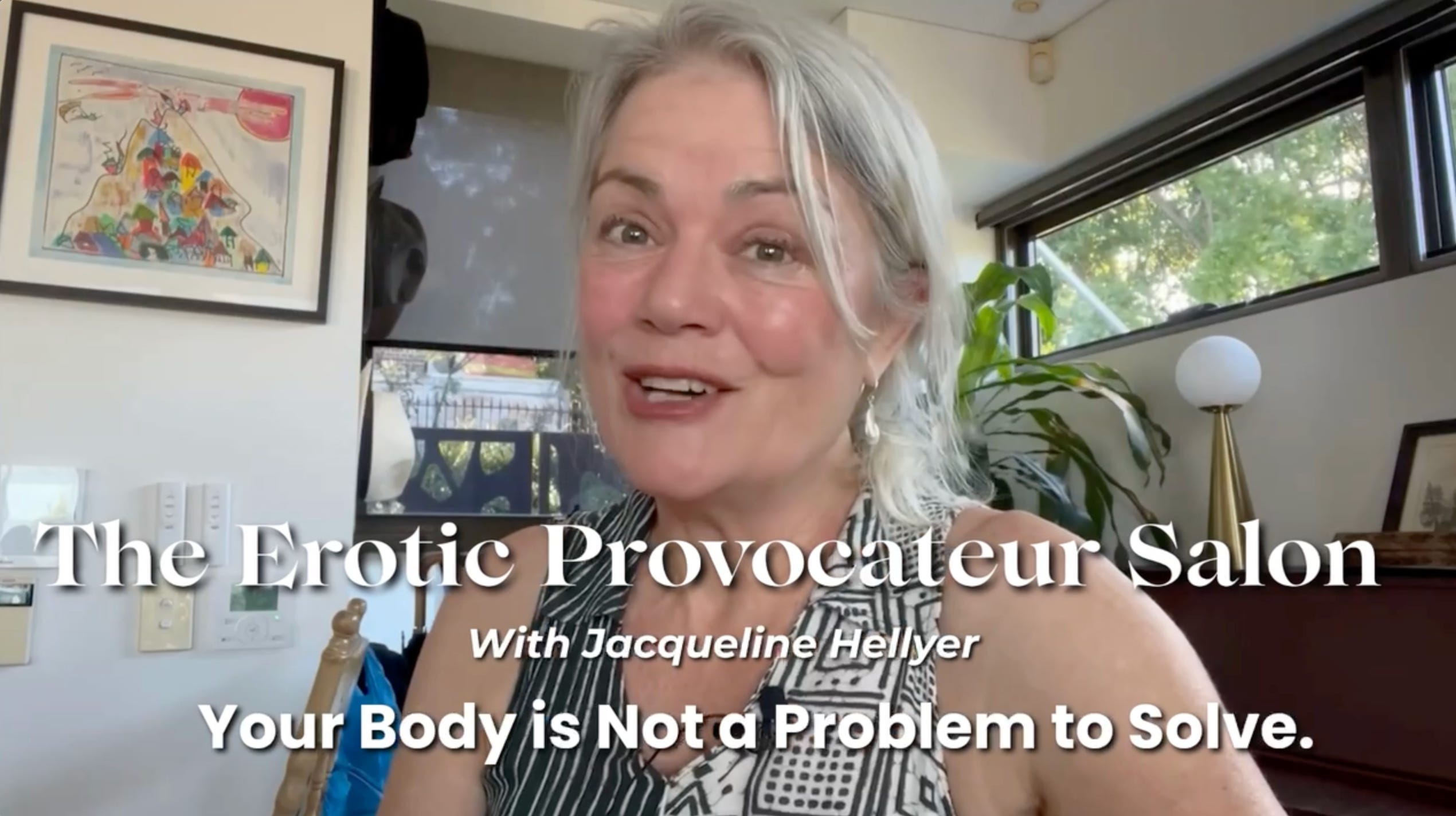
I’m now at a stage where my hair has turned almost entirely silver. I like to think of it as a silver crown, a sign that I’ve entered what might be called the “sovereign stage” of life. A stage where you’ve done the learning of youth. You’ve built your career, perhaps a family, perhaps a body of work in the world. And now you can rule over your creation like a queen.
It’s a stage where a woman knows herself. Where she becomes less interested in being approved of and more interested in being fully alive.
And my wrinkles? They give my face life. A perfectly smooth face may photograph well, but a lived-in face tells a story.
Coming Home to the Body
If we are serious about true empowerment, that is where we begin. Not by teaching women to correct their bodies endlessly. But by helping them inhabit them more fully.
To move. To feel. To express. To dance. To laugh. To make love. To live.
Because erotic aliveness, the kind of aliveness that nourishes intimacy, creativity and joy, does not come from perfecting the body. It comes from coming home to it.
Your body was never a problem to solve.
It was always a place to live.
Continue the conversation in the Salon.
It’s where I expand on each Erotic Provocateur essay with short, informal video reflections and deeper insights.