


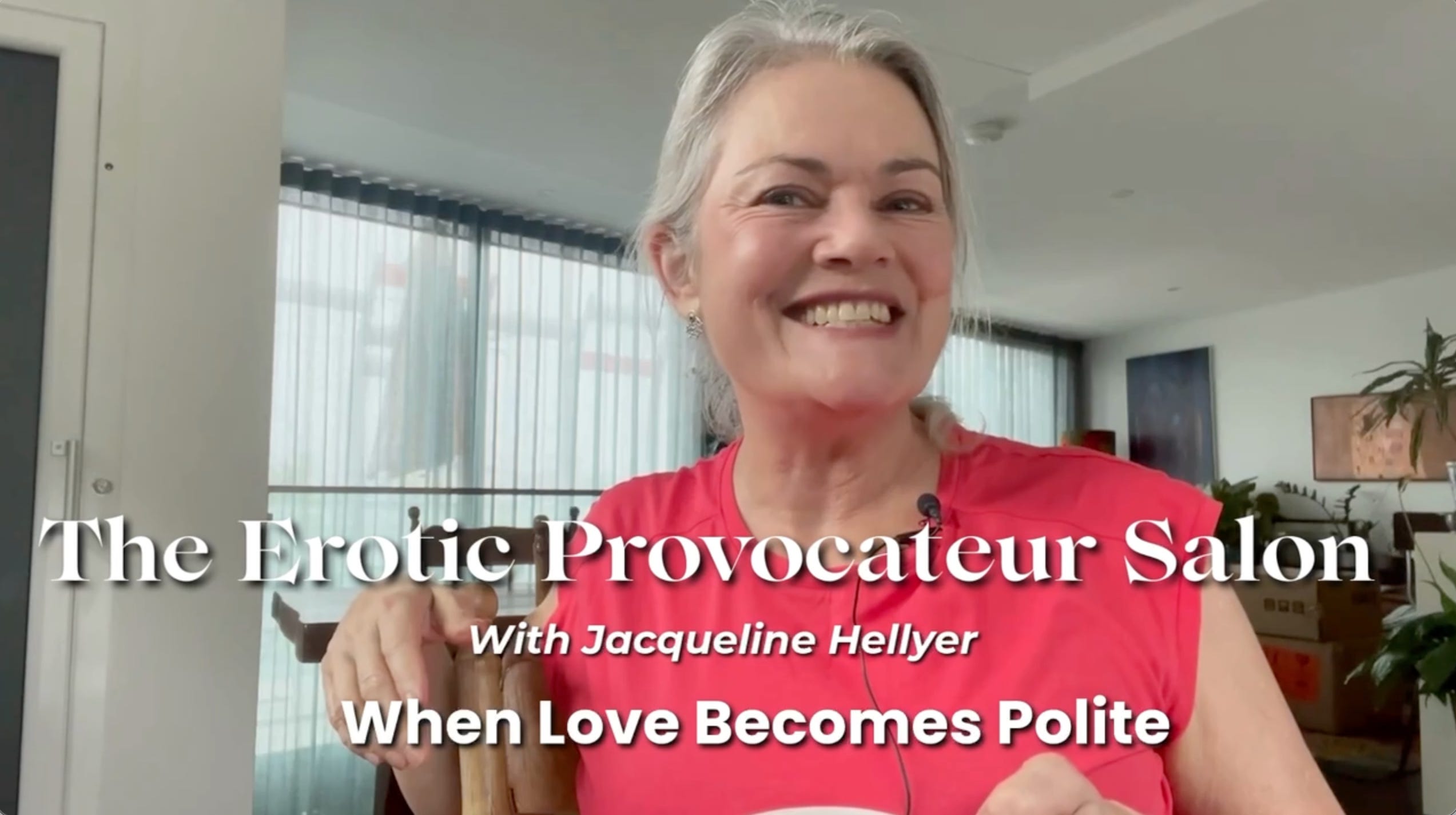
One of the quietest killers of erotic connection is not conflict, it’s politeness. And just as often, it’s complacency.
I don’t mean kindness or care, those are essential to a relationship, but that particular mix of being busy, being tired, being functional, and being “fine”. Nobody is doing anything wrong, but the relationship slowly loses its juice.
From the outside, these relationships often look good - you get along, you cooperate, you manage life together - but somewhere along the way erotic aliveness fades.
Not with a bang. But with a shrug. A dissipation…
When love becomes management
In many long-term couples, intimacy slowly shifts from something that is lived to something that is managed.
You manage the household.
You manage the schedules.
You manage the children.
You manage the finances.
You manage emotions.
You manage stress.
You manage each other.
Over time, partners can start relating more like colleagues or co-parents than lovers.
And a subtle but profound shift develops from: meeting each other to managing each other.
Eroticism does not thrive in management mode. It lives in presence, not performance.
It thrives in contact, not coordination. It blossoms in aliveness, not efficiency.
Niceness is not the same as intimacy
Many people believe that if they are kind, considerate and emotionally responsible, intimacy should naturally follow. But niceness is not the same as erotic intimacy.
Niceness often involves:
Holding back
Softening edges
Avoiding tension
Smoothing things over
Not asking for what you really want
Not naming what feels awkward, tender or alive
Eroticism, on the other hand, needs:
Aliveness
Energy
Presence
A willingness to be felt
A willingness to feel
This doesn’t mean being unkind or unsafe. It means allowing yourself to be real. Real is more erotic than polite.
Polite, busy… and unconsciously complacent
It’s so easy to become complacent in relationships. We’re busy people, we’ve got a lot on, we’re tired. There are children, work, stress, aging parents, admin, life….
So without really deciding to, we stop consciously tending the relationship. But without nurture, it withers and dies.
Complacency isn’t malicious. It’s unconscious.
When we get complacent, we stop being consciously engaged with our partner, or even with ourselves. We fall back into old patterns, inherited relationship models, limiting beliefs about love and sex, and unhelpful cultural myths.
We stop choosing. We start coasting. And coasting is not erotic.
From performance to practice
One of the most profound shifts couples can make is to stop thinking of sex as something you do, and start relating to it as something you practice.
Rather than it being a performance or a task or even a duty, you experience it as a practice. It becomes a way of meeting each other in the body, of cultivating presence, of staying connected to aliveness.
Otherwise, if sex is something you “fit in” or “tick off,” it starts to carry the same energy as everything else on the to-do list. So it’s no wonder it loses its magic.
Make sex your hobby (yes, really)
Here’s one of my favourite reframes for couples: What if your treated your sex life as a hobby?
According to the dictionary, a hobby is “an activity done regularly in one’s leisure time for pleasure.” That sounds like sex to me!
Think about how people treat their hobbies. Let’s say if scuba diving was your hobby, you wouldn’t just randomly show up every so often and hope for the best.
You’d:
Think about it
Talk about it
Plan for it
Do courses
Watch videos
Buy gear
Reflect on how it went
Get excited about the next time
Now substitute “have sex” for “go diving” and suddenly it becomes obvious how under-resourced most couples’ sex lives actually are.
People will happily invest time, energy, and money into coffee, cycling, gardening, travel, fitness, or sourdough starters. But when it comes to something as central to emotional connection, nervous system regulation, and relational satisfaction as sex? We often just hope it magically stays good.
But when sex becomes your mutual hobby, it becomes:
Easier to talk about
Easier to be curious about
Easier to prioritise
Easier to keep evolving
And it is much less likely to flatten out under the weight of politeness, busyness and complacency.
Conscious, not complacent
The alternative to politeness and complacency is not conflict, it’s consciousness. When you pay attention, you learn about yourself and your partner.
You notice what’s changing.
You name what’s flat.
You work with tensions instead of stepping around them.
You admit when you don’t know and get curious.
And you practice this together.
At first, being conscious in your relationship can take effort. But over time, with positive feedback and real results, it becomes easier, more natural and more alive.
And because you’re doing this together, the relationship itself starts to feed you back with more connection, more play, more erotic charge and a greater sense of us. You develop a positive feedback loop.
From polite to alive
Reclaiming erotic connection is rarely about learning new techniques - it’s about shifting how you show up.
From managing to meeting.
From polite to present.
From complacent to conscious.
From functional to alive.
It’s about letting yourself be a lover again, not just a partner, parent, or teammate.
Long-term love does not have to become polite. It can become deeper, richer, more embodied, more playful, more alive.
But only if you’re willing to stop coasting and start consciously meeting each other again.
If you’d like to sit with me a little longer, I’ve recorded a Salon video where I unpack the ecosystem idea in more depth.
Please join me below…