


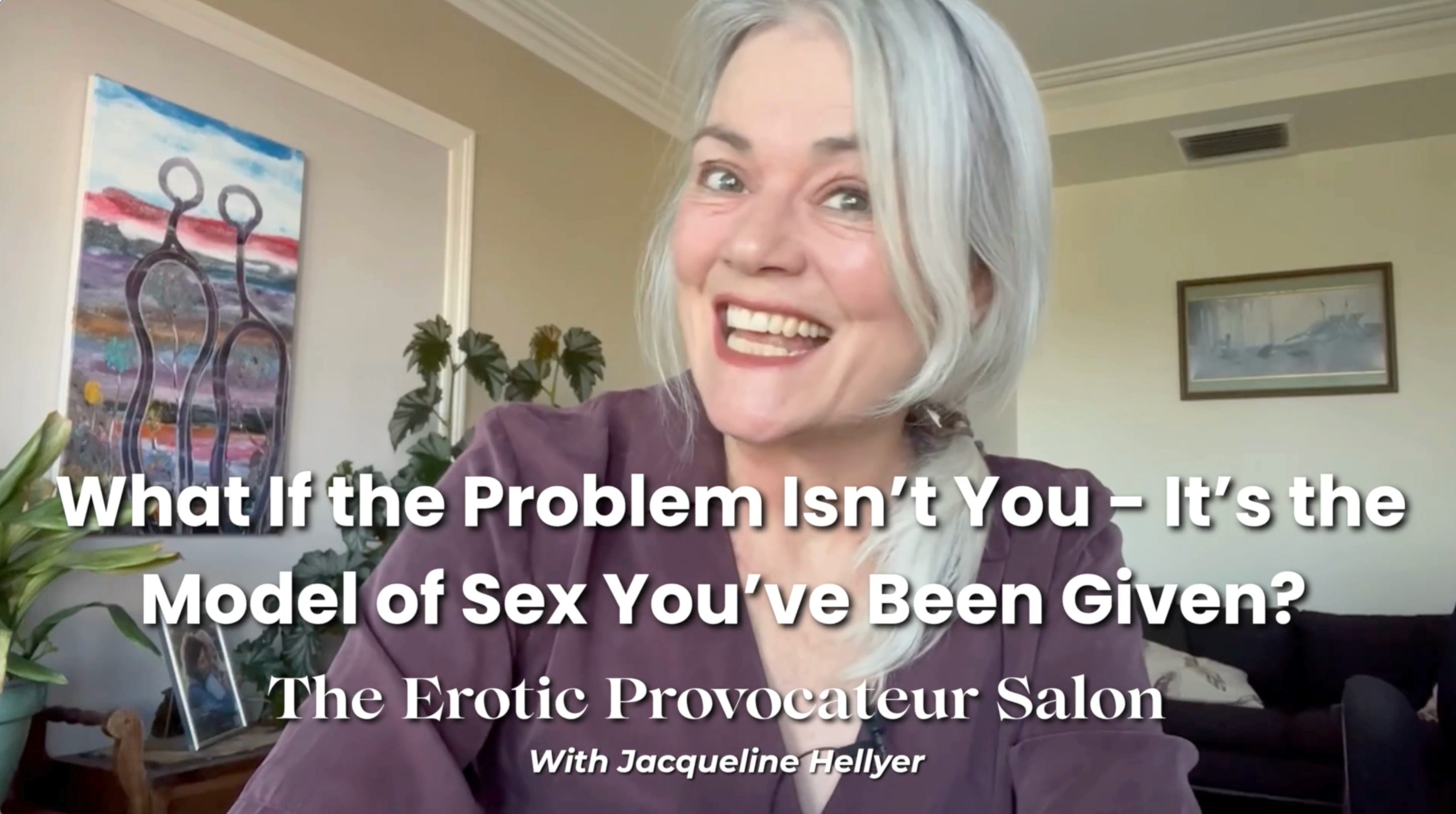
One thing I see again and again in my work is people believing there’s something wrong with their sexuality. We seem to be living in a time of widespread sexual dysfunction.
Everyone seems to have a problem - low desire or difficulty with arousal or trouble reaching orgasm or mismatched libidos or performance anxiety…
All day every day I see people presenting with these ‘dysfunctions’.
But you know what? We can’t all be sexually dysfunctional.
What if the problem isn’t the people…it’s the model of sex we’ve inherited?
The Standard Model of Sex
The dominant model of sex is surprisingly narrow. It’s linear, it follows a sequence, and it has an implied destination.
The process goes like this:
- you start with arousal (you’re supposed to already be aroused—if you’re not spontaneously horny, you have a ‘dysfunction of desire’),
- then you move into genital stimulation (and if you have problems there, you have a ‘dysfunction of performance’),
- and then you finish with an orgasm, his at least (and if you have problems there, you have a ‘dysfunction of orgasm’… or again, for the blokes, more ‘dysfunction of performance’).
So many potential dysfunctions, and all based on this one, very limited model we’re ascribing to.
Along the way, there are these unspoken Key Performance Indicators:
Did we both get aroused?
Did we do it “properly”?
Did we both have orgasms?
Was it frequent enough, long enough, good enough?
Quantitative assessments of what is, at its heart, a qualitative experience.
And when you look more closely, you see that even when we’re with another person, the structure is often still fundamentally solo. Sex is framed as two individuals, each trying to “get there”.
Now hopefully this is done generously — I’ll get you off, then you get me off — but it’s still operating within the same underlying framework. In other words, much of what we call partnered sex is essentially: mutual masturbation.
And while there’s nothing inherently wrong with that, it is a very limited model on which to base an entire sexual culture.
The Pressure It Creates
This model creates a particular kind of pressure.
If sex is a process with an expected outcome, then:
you can succeed or fail
your body can cooperate or not
your partner can be satisfied or disappointed
So it becomes very easy to feel:
not good enough
not sexual enough
not responsive enough
And so people conclude: There must be something wrong with me. Or with my partner. Or with us.
But what if there isn’t? What if you’re simply trying to fit yourself into a model that was never designed for the complexity of real, relational sex?
A Different Way: Non-Linear Lovemaking
There is a better way of understanding sexual connection.
Not as a linear process…but as something non-linear, co-created, and unfolding.
In this orientation, sex isn’t something you progress through. It’s something you experience together. There is no fixed sequence. No required steps. No expectation that just because we are doing this, we must of necessity move on to that. There is no particular outcome you have to reach.
To use one of my many food analogies, rather than experiencing sex like a three-course meal—where you have to move through the set structure—it’s more like a picnic.
Everything is out in front of you, and you can have whatever you like, in any order, in any quantity, and at any pace.
Everything is there, available:
you can move towards each other
away from each other
pause
change direction
deepen
soften
You can stay in one place for a long time. You can shift constantly. You can stop altogether. Nothing has gone wrong.
Consent, Moment by Moment
In this non-linear model, consent changes too. It’s no longer a single “yes” at the beginning of a predefined process.
It becomes: What am I feeling now? What do I want now? Where are you at?
Moment by moment.
And because there is no script to complete, there’s no pressure to continue somewhere you don’t actually want to go. You are simply doing what feels right in that moment.
And the way you know is very simple. You ask yourself two questions: Is this connecting? and Is this pleasurable?
If the answer is yes, you continue. And if not, you change what you’re doing—or bring it to a close.
From Performance to Pleasure
Most importantly, the focus shifts from performance to experience.
From:
How often?
How long?
How many?
To:
Does it feel good?
Does it feel mutual?
Do I feel connected?
Am I present?
Am I free to express myself?
These are not Key Performance Indicators. Consider them Key Pleasure Indicators.
And when you start orienting around these, you’ll find that many of the so-called “problems” begin to dissolve.
Not because you’ve fixed yourself…but because you’ve stepped out of a model that was creating the problem in the first place.
What Becomes Possible
This doesn’t mean orgasms disappear. Or that intensity isn’t possible.
In fact, the opposite is often true.
But when there’s no pressure to perform or achieve, the body relaxes. And when the body relaxes, it becomes more responsive.
And when there’s no fixed destination, the experience can deepen in unexpected ways. Pleasure expands. Connection deepens. Sex becomes something you share, rather than something you do.
The Provocation
We’ve inherited a model of sex that is:
linear
goal-oriented
performance-based
And then we wonder why so many people feel disconnected, anxious, or inadequate—with a myriad of sexual ‘dysfunctions’.
It’s time to question the model itself. The linear approach doesn’t work. We need to go non-linear.
We need to let go of the idea that sex has to go somewhere.
Let go of the need to ‘get it right’.
Let go of the quiet pressure to achieve.
And instead…
Turn towards what is actually happening—right here, within you and between you, moment by moment.
The sensation.
The connection.
The unfolding experience.
Not assumed, but co-created.
Then everything shifts.
What once seemed like a problem… may simply dissolve.
And what remains is something far more alive, more spacious, and more real.
So here is my invitation to you:
If you were to let go of the linear model, and approach sex non-linearly…what would your body, your heart, your soul actually express?
If you’d like to go deeper into this topic, please join me in the Salon below where I share in a more chatty, intimate way.