


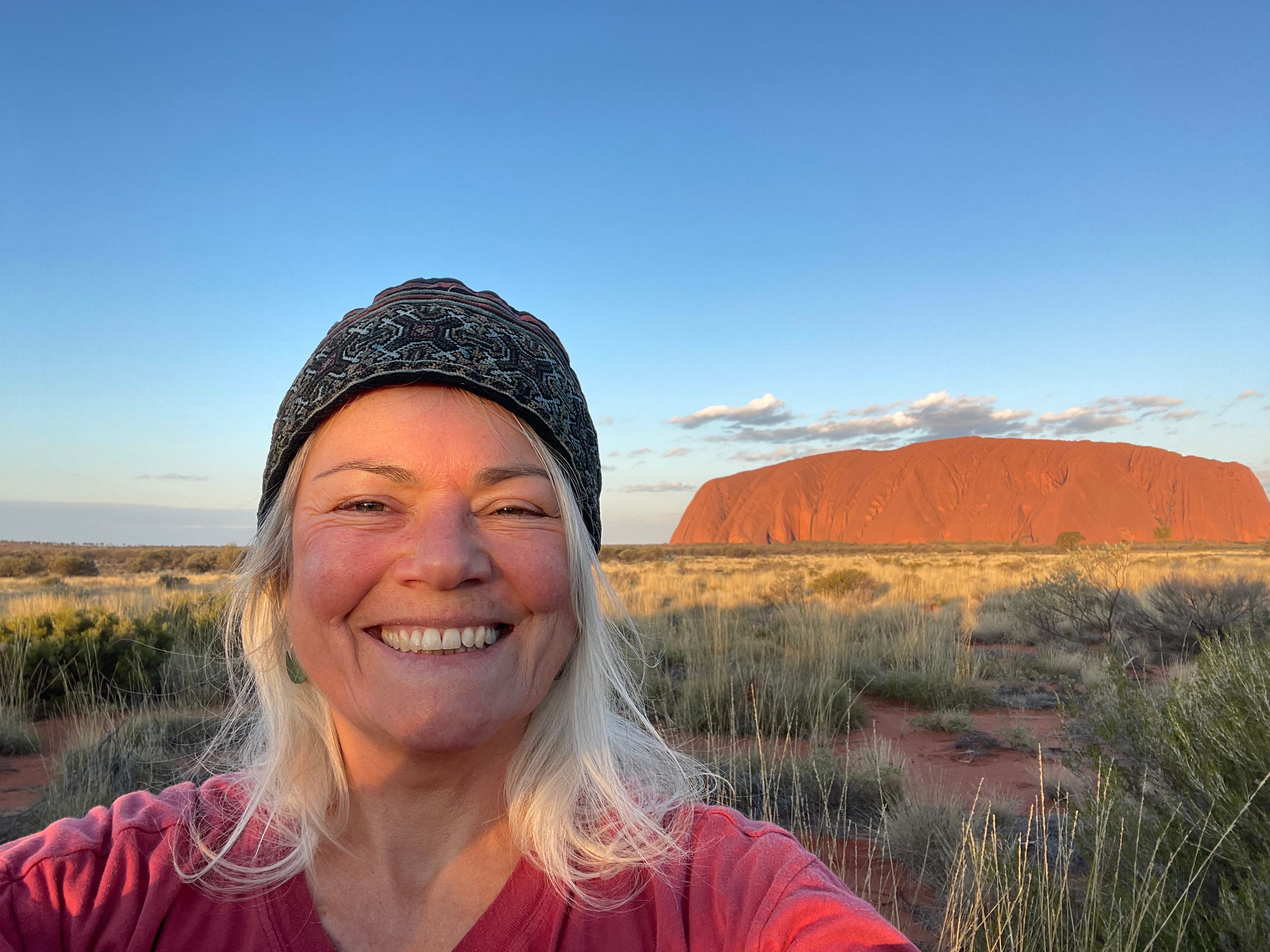
The other morning I was sitting quietly meditating when a kookaburra laughed.
Now there’s nothing particularly remarkable about that as I live in Australia - see above photo! Kookaburras laugh, they’re part of the environment.
But in this case, I really noticed it. I didn’t just hear it, I felt it.
There was a little frisson through my body. It was a momentary sense of connection and beauty, a sense of being part of something beyond myself. It felt as though the boundaries between me sitting here and the world out there were softening.
It was a tiny little moment, but it felt numinous. And, to me, it was erotic.
Now, I don’t mean that hearing a kookaburra turned me on (that would be a weird kink!) I mean erotic in a much broader sense than we generally use the word. We tend to equate the erotic with the sexual, and the sexual with the genital. And I think we’ve made both far too small.
This anecdote is telling — some years ago, a woman who had attended one of my retreats contacted me and told me that the year since the retreat had been the most sexual year of her life…
…yet she hadn’t had sex once.
I knew exactly what she meant. She had experienced becoming more available to the erotic nature of existence.
Oh... LIFE!
When I talk about the erotic, I’m talking about a life force, an animating energy. It’s a vibrancy that underpins our experience of being alive.
For me it encompasses presence, embodiment, sensuality, awe, wonder, beauty, connection, joy.
It’s not simply, Oh, life is good. It’s Oh... LIFE! (Listen to the recording to hear me say that!)
When you’re engaged with the erotic, the world becomes more vivid. It’s less a fleeting experience than a way of being in the world with more presence and receptivity, more alive to what is around and within you. Of course, there are moments when that erotic aliveness becomes particularly palpable: such as dancing, swimming in the ocean, listening to music, creating something, eating an exquisite meal, making love, meditating, standing beneath a starry night sky, or noticing a dragonfly hovering beside you. Some experiences simply make that aliveness easier to feel.
There’s often a sensual quality to it because we’re experiencing life through the body. And sometimes there’s an actual bodily frisson, such as goosebumps, shivers, tingling, warmth, trembling, a feeling of expansion or energy moving through us.
I often experience this in meditation. Sometimes I’ll feel shivers or tremors moving through my body, accompanied by a very tangible sense that something has shifted, that my consciousness has entered a different state, or perhaps, in my more spiritual interpretation, touched another realm.
(And sometimes I sit there for twenty minutes thinking about what I need from the supermarket… Such is the spiritual path…)
But these more palpable experiences aren’t the erotic itself, they’re moments when I become particularly aware of it. The erotic, as I understand it, is something we can cultivate an ongoing relationship with. It’s a way of inhabiting ourselves and engaging with life that makes us more receptive to its beauty, sensuality, connection and vitality. It doesn’t require a dragonfly, a mystical experience or a shiver up the spine. Those things simply remind us of what is already there.
Years ago I came across a story that I’ve never forgotten. I’ve long since lost the source, and I can’t vouch for the exact wording, so don’t quote me quoting this quote!
But apparently someone once asked a Buddhist monk how he coped with not having sex, and his response was something along the lines of:
Why would I need sex? I’m orgasming all the time.
I loved that. Not because I think enlightened Buddhist monks wander around in a permanent state of climax, but because it points towards something I’ve been trying to articulate throughout my work.
What if orgasmic isn’t merely something that happens to our genitals? What if it’s a quality of our availability to life?
And being erotically engaged with life doesn't mean wandering around in a permanent state of bliss. Life includes grief, disappointment, boredom, pain and loss. Being more available to life means being more available to all of it. The erotic doesn't take the difficult parts away, but I find that connection with that underlying aliveness gives me greater capacity to move through them.
The erotic life force
I’ve spent my life exploring these questions — through science, psychology, sexology, philosophy, religion, spirituality and metaphysics, as well as through clinical work, lived experience and meditation. (I sometimes joke that I came out of the womb questioning. Apparently I was rather a strange child with strange questions and interests…)
And increasingly I’ve come to understand the erotic not as something confined to sexual activity, but as an embodied participation in aliveness.
Now, I’m not particularly interested in proving exactly what this life force is. We could head down all sorts of fascinating rabbit holes involving consciousness, electromagnetism, quantum physics and the nature of reality. (And I’d happily spend an afternoon doing so!)
We don’t need to settle the metaphysics in order to recognise the experience. We know what it feels like to be shut down, to go through the motions, to live mostly in our heads, and to be stressed, defended, armoured, distracted, and/or constricted.
And we know, or at least I hope we’ve all at least occasionally known, those other moments when something opens and we become more present. And in those states we become more sensitive, more receptive and more able to feel.
So the erotic isn’t something we create — it’s something we become available to.
A very Yin kind of aliveness
This is where my preferred language of Yin and Yang becomes useful.
We live in a profoundly Yang culture. We value doing, striving, achieving, intensity, productivity, visibility, action.
And I think we’ve Yang-ified (is that a word?) sex accordingly: more stimulation, more movement, more excitement, more intensity, bigger orgasms, more orgasms. As I’ve been exploring in my recent essays, we’ve become very focused on summit-bagging.
But I think we’ve done something very similar with spirituality, we’ve Yang-ified it too: we don’t just want to meditate, we want enlightenment; we don’t want to feel a subtle movement of energy, we want the kundalini rush; we don’t want an exquisite moment of connection, we want the cosmic orgasm; we don’t want an altered state, we want the full psychedelic breakthrough.
Bigger. Higher. More intense.
We even talk about spirituality spatially. We want to reach a higher state of consciousness, to rise above the physical, to transcend the body.
It’s all terribly Yang. Although there is nothing inherently wrong with Yang. Those extraordinary experiences can be extraordinary when they arise. But I do believe we can mistake intensity for depth.
The erotic, as I understand it, begins somewhere quieter. It begins in receptivity, in noticing, in allowing ourselves to be affected, and in becoming sensitive enough to perceive what is already there.
The kookaburra laughs. The light falls through the trees. Someone we love reaches for our hand. Our skin registers the breeze.
Something beautiful enters our awareness and, instead of rushing past it on the way to the next thing, we let it in and we allow its beauty to nourish us.
That’s profoundly Yin. And from there, enormous Yang experiences might arise — energy might surge, passion might erupt, we might have the cosmic orgasm.
All fabulous.
But we don’t have to.
Down and in
This is also why I’ve always been drawn to spiritual traditions and philosophies that don’t position spirituality as an escape from physical existence.
When I was doing my Masters in Consciousness, Spirituality and Transpersonal Psychology, I encountered the work of Jorge Ferrer and his concept of Participatory Spirituality and it resonated with me enormously.
Rather than spirituality being something that happens when we somehow transcend our messy physical humanity, Ferrer describes spiritual knowing as participatory — embodied, relational, and very much connected with our participation in life. That makes far more sense to me.
There are resonances here with the Taoist concept of the Way, and wu wei, of not forcing and striving, but learning to move in accordance with the flow of life.
And with strands of Tantra that don’t treat the body and material existence as impediments to spiritual awakening, but as pathways through which it can occur.
Nietzsche, who railed against philosophies that devalued earthly life in favour of some supposedly higher realm, urged us to “remain true to the earth.”
I like that. It’s not up and out of the body. It’s down and in.
These approaches point to the spiritual not being found by transcending the physical, but by becoming exquisitely available to it.
I know that the more embodied I become, the more I seem to notice — myself, another person, the natural world, beauty, subtle sensation, the spaces in-between…
…and sometimes the distinction between me and everything else becomes a little less solid. So much of what keeps us feeling separate is protective — our fear, our armour, our need to defend ourselves. When we feel safe enough for some of that protection to soften, we can open. And when we open, we become more available to connection.
Not just connection with another person, but with life itself.
And for me, there is often love in that experience. Not romantic love, or even love directed towards something in particular, but a kind of pervasive lovingness. A sense that love is somehow woven into existence itself.
I’m no longer standing over here observing life happening over there. I’m participating in it, and it feels good.
And this brings us back to sex
Because while the erotic is so much larger than sexual activity, lovemaking can be one of the most potent places in which we experience it, particularly when we’re making love with someone we deeply love.
Think about what can come together in that experience: Embodiment. Sensation. Pleasure. Love. Presence. Connection. Beauty. Receptivity. The softening of the boundaries between self and other.
At its most profound, we’re not simply doing sex, we’re opening ourselves to an experience that can become deeply intimate, expansive, and even numinous.
This is part of what has always drawn me to Tantra. In some Tantric traditions, the body and sexuality aren’t obstacles to spiritual experience. Sexual union itself can become one possible and potent doorway into it. The physical doesn’t have to be transcended in order to reach the sacred. The physical can become the way in.
And this is where I think we get conventional sex almost exactly backwards.
We tend to think that the sexual activity creates the erotic experience. We think that if we do enough sexy things, stimulate ourselves and each other in the right ways, generate sufficient arousal and achieve suitably impressive orgasms, we’ll have great sex.
But what happens if we approach it from the other direction? What if we first become present? If we are open, embodied, and receptive? So that we become available to ourselves, to our beloved, and to all the sensation, beauty and love and whatever else might emerge between us.
And then we make love from there?
We don’t have to manufacture intensity or chase the erotic experience. We bring our erotic availability with us. Sometimes that might lead to something wild and intense and ecstatic. Sometimes we might barely move. Both can be deeply erotic.
It’s not that sex creates the erotic. It’s actually that the erotic transforms sex.
Becoming available
There is science that helps us understand this concept to some degree.
The field of interoception explores our capacity to perceive signals arising from within our own bodies, and how that relates to emotion, self-awareness and wellbeing.
Mindfulness research points towards the effects of present-moment, non-judgemental awareness on our relationship with our bodies, including our sexual bodies.
And we know that chronic stress, distraction and hypervigilance can interfere with our ability to notice and attend to what's happening within our bodies.
None of this scientifically demonstrates the existence of an “erotic life force”, and it doesn’t need to. Science can help us understand some of the mechanisms through which we become more capable of sensing ourselves and our world. Spiritual traditions and philosophy offer other ways of interpreting what we encounter there. And our own bodies offer another kind of knowing altogether.
What interests me is what happens as we become less armoured, less constricted, less defended and more embodied. We become more capable of receiving, more capable of participating, and more capable of experiencing the erotic.
And perhaps that’s really what I’m talking about when I talk about cultivating our erotic capacity. It’s not about becoming more sexual, or having bigger experiences. It’s certainly not about trying to orgasm our way through life.
It’s about becoming more available to life.
So that we are more able to feel, more able to receive, more able to connect. We become more able to experience beauty, pleasure, love and the extraordinary within the ordinary.
When we bring that into our lovemaking, sex becomes something quite different.
Sex doesn’t create the erotic. The erotic transforms sex.
But sex is only one place we can experience it.
Sometimes we’re simply sitting quietly on an ordinary morning...
…and a kookaburra laughs.
And we notice.
And it feels good.
The Salon
Please join in me in the Salon where I expand on the topic of the erotic in an informal discussion.
I can relate to your experience/s of meditation!
Love this meditation on the erotic, its beauty and, as I understand it, reality. Inspirational and instructional.