


Consent matters. But consent alone is not enough to create safe, nourishing, mutually alive sexual relationships.
Consent has become an important topic, one that is absolutely necessary, important and overdue. However, as an accredited Psychosexual Therapist who has spent over twelve thousand hours talking in intimate detail with people about their sex lives, I know that as well-intentioned as the consent conversation is, until we start addressing what comes before consent, we won’t solve the problem of people being able to give consent.
We tend to assume we know what sex is and what it is we are consenting to or not. But do we? We can’t consent if we don’t know the parameters, our own internal assumptions, of the thing we are consenting or not to.
What is Sex?
The first question I ask people when they come to me with their myriad issues, the essence of which comes down to being able to navigate sexual relating, is ‘what is sex’? The immediate response to which is generally a puzzled-look followed by, ‘oh, I’ve never really thought about that before.’
This is the problem – what do we mean when we refer to sex? What are we consenting to? So many people have a very limited view of sex, one that is generally framed within an inherited, hierarchical and performance-based sexual script – that sex is something that one person does to another and the other has to agree to or say no. Even in same sex attracted couples I often see this approach: I have to agree to what you want, or what I think you want, or I say no.
Our language is riddled with words that promote this. Take the term ‘penetration’ – who on earth thought that such an aggressive word was appropriate for the act of sex. And who does the ‘penetrating’? The penis owner! Why not call it ‘envelopment sex’ and move the focus to the vagina inviting, welcoming in and embracing the penis? (I can assure you that I’ve solved a lot of ‘women’s sexual dysfunctions’ simply by changing the language.)
This tends to be accompanied by another unhelpful belief that sex is a linear process. It has a ‘green light’ early on followed by a series of supposed milestones that have to be met, leading to the ultimate and final one of the male ejaculation. Then the act is complete – and hopefully she’s had an orgasm along the way.
So many people say they have sex because ‘that’s what you do – don’t you?’. So many young people I see view sex as what they see on porn, they feel they are consenting to those behaviours. So many people in long term relationship view sex as something they have to do to keep their partner happy. Interestingly, aside from a small proportion of entitled folk (and that’s just as often a woman as a man) most people are more concerned about their partner than about themselves.
Of course, this does not negate the reality of sexual coercion, abuse, and violence, which remain devastating and real. But if we only teach consent as a rule without teaching what healthy, mutual, relational sex actually is, we leave people without the inner compass to navigate intimacy safely.
The Language of Sex
Let’s take this a step further – not only are people not conceptualising what sex is for themselves, they’re not discussing it with their partner. Even couples who have been together for decades don’t talk about sex much beyond the ‘sex tonight dear?’ – unless it’s a problem, in which case they can talk about it endlessly in a most unsexy way. Even though most people would say that they want a positive sex life, very few go anywhere near the depth of discussion that is required to be able to co-create something meaningful.
Note the language I’m using here. Firstly, “co-create”, yes, sexual intimacy needs to be co-created. It needs to be ‘where are you at’ and ‘where am I at’ and from that we co-create. Not just at the start of an interaction, but all the way through — moment by moment, breath by breath. And secondly, “meaningful” – what is the meaning of sex? The model of sex as ‘getting each other off in the way that we think we should be without talking about it or even wondering why’ doesn’t work. We need to understand the why.
And to do that we need to step outside the sexual script that we inherited from long histories of repression, hierarchy, and disconnection from the body, which, while it’s been around for a very long time, does not represent what really drives humans sexually. Let me be brief: most other mammals only have sex to reproduce, when the female is fertile, and there is no ‘fatherhood’, their infants are self-sufficient enough for a mother to manage them on her own. But humans have big brains and big skulls, so we have to give birth to our young when they are very helpless or they wouldn’t fit out the birth canal. A prehistoric mother couldn’t raise an infant to a viable age on her own. There was evolutionary pressure for the fathers to stay around. Men who embraced fatherhood were more likely to have offspring who reached reproductive age and continued their gene line.
Parents who bonded and loved and supported each other and their vulnerable young were the ones whose genes survived. How, in part, did this bonding happen? Through activities that released the bonding and pleasure hormones – sexual intimacy, from touches, hugs, kisses to all kinds of genital engagement.
Sex is a Bonding Activity
Sex in humans is primarily a bonding activity. The emotional component is an essential part of quality sex in humans. We need to embrace it as such and teach our young people that. It is something that two people do to create connection through pleasure. There are no other checklists. It is a moment-by-moment co-creation where each brings to the moment their true selves.
I know clinically that this shift in attitude changes everything. It moves it from performance to self-expression, from a physical behaviour to an emotional, dare I say spiritual, connection. Let’s move the consent conversation in society at large in the same direction. Let’s talk about the beauty and the goodness and the mutuality of sex and inspire our young people to engage in a way that is pleasurable and life-enhancing. And as their parents and elders, let’s sort out our own sexuality so that we can model and discuss sexuality as the important and wonderful part of life that it can be.
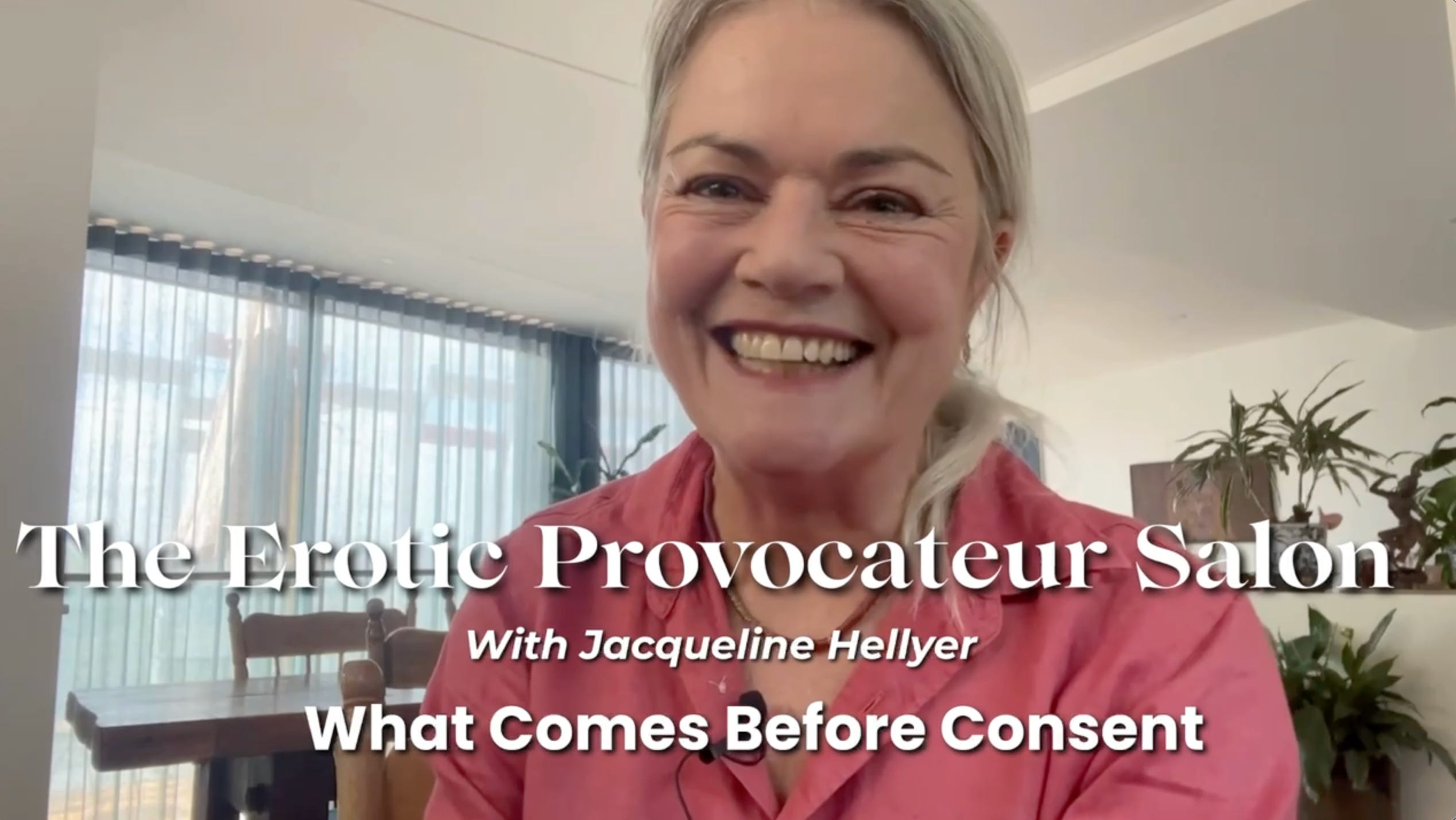
If you would like to stay with me longer, please join me in the Salon in the video below. It’s a more casual, chattier dive into the topic of What Comes Before Consent.