


I’ve been working with couples and individuals for more than two decades and there’s one pattern I see everywhere: Modern life has trained us to chase dopamine instead of cultivating connection.
We shouldn’t blame ourselves, it’s not our fault. Given that our society encourages and rewards stimulation rather than presence, novelty rather than depth, intensity rather than pleasure, and speed rather than true feeling, it’s not surprising that we bring that same approach into the bedroom.
Years ago I wrote an article on my LoveLife Blog called The Yin and Yang of Erotic Physiology, where I explained how healthy sexuality depends on a dance between the softer, nourishing yin and the more energised, exciting yang. That applies even more so now than when I first wrote it. We live in a society so caught in yang, so driven by dopamine spikes, that it’s not only eroding our erotic wellbeing but our capacity for sustained happiness in general.
Let me explain.
Dopamine vs Serotonin: Two Very Different Love Stories
We have two neurological pathways that shape how we feel.
1. The Dopamine Circuit — the “hit”
This is the circuit of craving, reward, novelty, intensity, and wanting more. It spikes fast, burns fast, and crashes fast.
This is the realm of:
porn-driven arousal
high-stimulation sex
swiping
chasing the next sexual “fix”
intensity-based intimacy
anything that feels like a “rush”
Dopamine itself is not a problem, it can create excitement and aliveness in healthy doses. But dopamine on its own is not designed to sustain long-term pleasure or long-term love.
2. The Serotonin Circuit — the “state”
This is the circuit of contentment, groundedness, presence, relational safety, and deep satisfaction. It’s subtle, slow, stable, and nourishing.
Serotonin is what allows us to:
feel calm and alive at the same time
enjoy the warmth of touch
sink into connection
savour erotic presence
feel fulfilled rather than hungry
It’s the realm where real erotic aliveness lives.
A healthy, thriving sexuality depends on a balance, the same yin/yang dance I wrote about years ago. The problem is that our culture has shifted way too far toward dopamine dominance.
How We Became a Dopamine-Driven Culture
When you think about it, it’s not at all surprising, given that our economic system thrives on dissatisfaction. To keep people endlessly consuming and wanting more, marketing has become extremely good at stimulating the dopamine pathway with it’s promise of “more,” the next hit, the next escape, the next excitement.
But that comes at a cost: our collective nervous systems are depleted, our attention spans are fragmented, and our capacity to sit in stillness (where erotic energy actually arises) is shrinking.
And so we see this play out in our sexuality.
Porn in particular has rewired millions of nervous systems toward intensity-based arousal. It trains the brain to seek the visual, the novel, the extreme, the fast — all dopamine, no serotonin. It disconnects arousal from the presence of another human being and ties it to fantasy, performance, pressure, and tension.
I see the effects in my clients all the time:
people unable to feel pleasure without intense stimulation
numbed arousal
trouble staying present
difficulty connecting emotionally during sex
a sense of “emptiness” after orgasm
partners feeling rejected or inadequate
highly stimulated nervous systems unable to downshift into pleasure
And it’s not just porn. Social media, digital over-stimulation, speed-driven work cultures, and constant novelty all condition the brain toward spikes rather than steadiness. Which makes the subtle, nourishing, relational aspects of sexuality harder to access.
So couples get stuck in one of two cycles:
Cycle 1: “We’re not having sex.”
This cycle is because the nervous system is so stressed or depleted that erotic energy can’t emerge.
Cycle 2: “We’re having sex, but it doesn’t feel good.”
This cycle comes from believing that sex comes from excitement rather than connection, so they focus on the wrong thing and sex feels disconnected and forced.
Both are symptoms of the same underlying issue: dopamine-dominant living and loving.
The Crash After the “Big O”: The Dopamine Drop
Now let’s look at what happens after orgasm. If sex is heavily dopamine-driven and orgasms are tense, forced or rushed, then there is often a dopamine crash afterwards.
People describe this as:
irritability
emotional distance
feeling “over it”
feeling disconnected
wanting space
lack of tenderness
sudden shutdown
Does that sound familiar?
This isn’t a relationship issue, it’s a biochemical one. Without enough oxytocin, vasopressin, and the parasympathetic “afterglow,” dopamine-driven orgasm can feel like a comedown.
Which is why I teach couples that pleasure is not the peak, it’s the path. And that path is built on serotonin-based connection, not dopamine-based intensity.
The Nervous System: The New (and Original) Love Language
The nervous system is the true centre of all erotic experience.
When your nervous system is overstimulated and depleted your capacity for pleasure and connection diminishes.
But when your nervous system is settled and present, erotic aliveness returns on its own.
This is why at my Couples Retreats, I begin with a meditation on what I call “alert relaxation”, the nervous system in balance. It’s not a nice add-on, it’s the physiological foundation for intimacy.
A regulated nervous system is a sexually responsive nervous system.
The Slow Return to Aliveness
When you restore the nervous system, the need for dopamine-driven stimulation naturally declines. You find that presence replaces craving, pleasure replaces performance, and true connection replaces endless pressure.
Many spiritual, somatic, and mind-body practices can help people return to themselves, to reclaim the subtler, deeper states that make life (and love) feel juicy again.
But we don’t need monasteries, we need practice. And for couples, that practice is wonderfully simple.
The Path Out of the Dopamine Trap: What Actually Works
Here are the pillars I teach in my work, drawn from psychology, neuroscience and the long lineage of Tantric, relational and embodied wisdom.
1. Slow everything down
Slowness is not the opposite of passion, it’s the gateway to it. When you slow down, serotonin has a chance to rise. The nervous system shifts from stress to readiness. You feel again.
2. Cultivate the Simmer Zone
This is my model for the sustained erotic field couples can live in daily life.
It’s built on micro-moments of affection, co-regulation, relaxed curiosity, and subtle sensual attunement. It is serotonin-based erotic aliveness, not intensity-based erotic chasing.
3. Connect before you touch
Mental, emotional and energetic connection activates oxytocin and down-regulates stress. Without it, the body doesn’t feel safe enough to open.
4. Engage the whole body, not just the genitals
Rather than rushing to the ‘good bits’, take your time with warm, expansive, playful, responsive engagement of the whole body. Allow for both yin and yang, dopamine and oxytocin, excitement and connection.
5. Let desire emerge instead of forcing arousal
The body knows how to open when it feels safe and alive. So when pleasure is allowed to emerge rather than chased, erotic energy builds naturally.
6. Make afterplay just as important as foreplay
Cuddling, chatting, soft presence, and ongoing touch help regulate dopamine drops and nourish the serotonin pathways that create ongoing satisfaction.
7. Build a beautiful environment
Lighting, music, tidiness, warmth — your nervous system responds to everything around you.
This is not superficial, it is deeply physiological.
The Return to Connection Is the Return to Ourselves
The truth at the heart of all of this is:
Feeling alive is the antidote to dopamine addiction.
When your nervous system is nourished and your relational field is healthy, you don’t need the hits, the spikes, the intensity, or the escapes.
You can feel pleasure in the subtle. Your whole body can feel arousal. You feel love as a lived experience, not a performance. Sex becomes spacious and co-created, not chased or squeezed in. You feel your true self.
When that happens, intimacy becomes what it was always meant to be: not a series of spikes, but a deep, steady, erotic hum — a living field between you and your beloved. It becomes a place where science meets soul, yin meets yang, dopamine meets presence, and where intensity might well be welcomed, but connection always leads the way.
This is the path out of the dopamine trap and back to erotic aliveness.
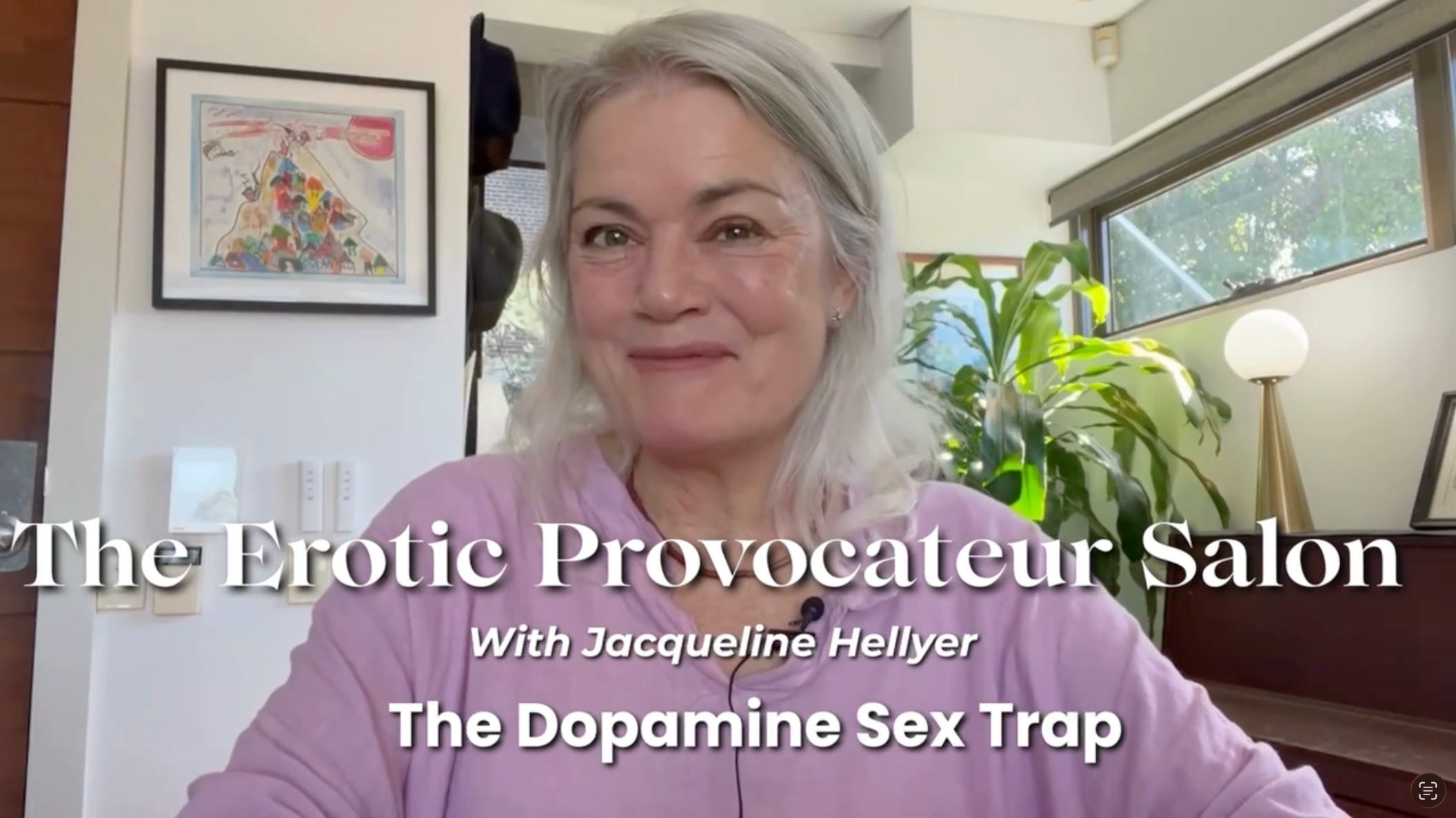
Continue the conversation in the Salon.
It’s where I expand on each Erotic Provocateur essay with short, informal video reflections and deeper insights.
Yes, as a society, we're losing the whole connection piece due to smartphone pre-occupation and if you're not deliberately regulating your nervous system everyday, that can become an issue to even get to the stage of slowing down enough to listen, talk, connect, touch, rather than thrill seeking. Great article, thanks.
I just wrote a piece on how to have good sex and I think that we have some interesting overlap!