


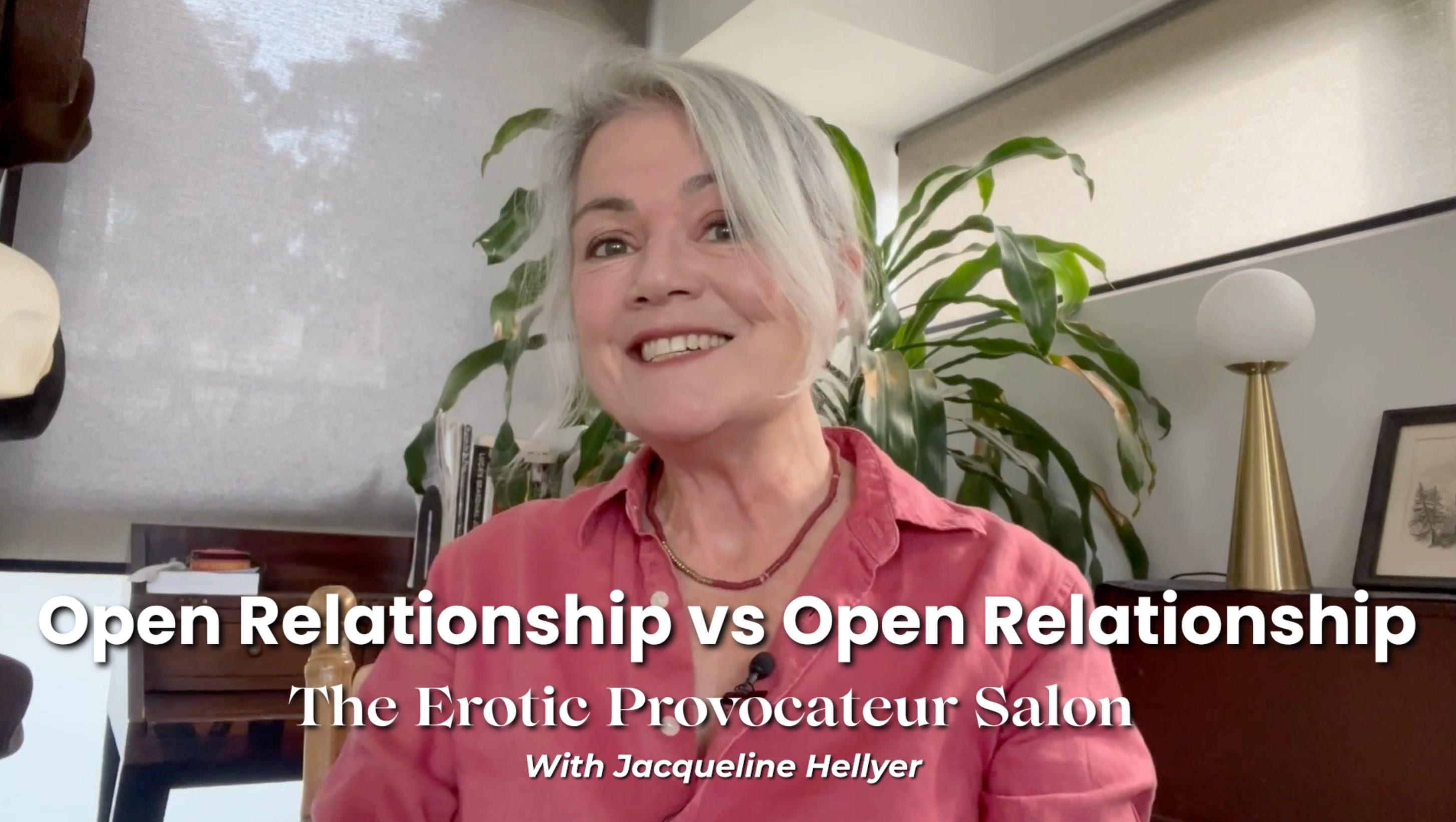
No, that’s not a typo. There are open relationships… and then there are open relationships.
One describes a relationship structure — a relationship that is sexually open to other people. The other describes a quality of relating — a relationship that is emotionally open, honest, vulnerable, alive.
And while those two things can coexist, they are not the same thing.
The Rise of the Open Relationship
Lately, I’ve noticed more people coming to me wanting to “open up” their relationship.
Usually, when we explore why, the reasons are understandable. Things have become a bit dull, predictable. Sex has fallen into familiar patterns and they want more novelty, more excitement, more aliveness.
And let’s be honest: open relationships have also become a bit culturally fashionable.
Now, I want to be very clear here. I am not against open relationships. They absolutely can work for some people. But neither am I against parachuting — and that’s not for everyone either.
If you’re going to jump out of a plane, you need preparation, skill, trust, good communication, clear safety protocols, and a properly packed parachute. Otherwise, what sounds exciting can become genuinely dangerous.
Opening a relationship is similar. It’s not morally dangerous, it’s relationally dangerous.
Because once you bring other people into the erotic field of a relationship, all sorts of things can arise: jealousy, insecurity, comparison, fear of abandonment, asymmetry of desire, broken agreements, unexpected attachments.
It is not impossible to navigate — many people do — but it requires far more relational skill than most couples realise.
The Surprising Thing That Often Happens
And here’s the interesting thing I’ve observed.
When couples start seriously discussing opening their relationship, they often begin opening to each other for the first time. They find themselves having conversations they’ve never had before. Conversations about:
Desire.
Fantasy.
Fear.
Boundaries.
Needs.
Insecurities.
Turn-ons.
Turn-offs.
Longings.
Resentments.
They begin communicating with more honesty, vulnerability, and transparency than they ever have before. And sometimes, something fascinating happens. As one client said to me recently:
“We’ve become so open with each other that we don’t actually need to be open with anyone else.”
Exactly. Because often the thing people are truly hungry for is not another person.
It’s aliveness.
And aliveness does not emerge simply from novelty. It emerges from openness.
From openness within the relationship.
From developing the capacity to speak honestly.
To listen non-defensively.
To reveal yourself.
To co-create.
To stay emotionally connected while talking about difficult things.
And to let desire move through the relationship instead of becoming trapped beneath politeness, routine, and unconscious scripts.
Emotional Closure is an Erotic Killer
So many couples are technically monogamous, but relationally closed.
They can’t safely talk about sex, or reveal their fantasies. They can’t say what they really want, or tolerate difference. They can’t navigate hurt without defensiveness or withdrawal.
Of course the erotic energy dies in a system like that.
Not because monogamy is inherently repressive.
But because emotional closure is.
Often, too, couples have simply fallen into unconscious sexual patterns — the same script, the same assumptions, the same unspoken dynamics. And over time, sex can begin to feel effortful, predictable, or disconnected from genuine desire.
Then along comes the seductive idea: Maybe we just need more novelty.
And yes, novelty does matter. Newness, excitement, anticipation — these things absolutely can energise eroticism.
But there’s a big difference between introducing more aliveness into a relationship… and outsourcing aliveness altogether.
Safety is What Allows Pleasure
This is why open relationships only tend to work well when there is already a strong foundation of openness within the relationship itself.
You need the capacity to communicate clearly.
To negotiate thoughtfully.
To express fears safely.
To create agreements together.
To repair ruptures.
To stay connected through discomfort.
In other words, you need relational maturity.
There are no universal rules here, any more than there are universal rules about how often your partner should go golfing with friends or spend time pursuing passions outside the relationship.
Every couple has to co-create what works for them. But whatever the agreements are, they need to protect the relationship itself. Because safety is what allows pleasure.
Without safety, the nervous system contracts. It defends, monitors, protects… and that’s not a very erotic state.
Open-Hearted Relationships
This is why I’ve become increasingly interested in what I call open-hearted relationships.
Relationships where there is enough emotional safety to be fully real.
Where people can speak vulnerably.
Reveal desires.
Share fears.
Explore fantasies.
Influence each other.
Stay connected through truth and authenticity.
Relationships where sex is not just driven from the genitals upward, by horniness alone, but from the heart outward.
“I love you.
I feel open with you.
I feel safe enough to reveal myself to you.”
That kind of openness is magnetic.
And ironically, when couples cultivate that kind of relational openness, they often find their erotic life becomes far more alive, creative, and expansive within the relationship they already have.
The Real Question
Now, if a couple already has that foundation and genuinely wants to explore sexual openness with others — wonderful. Some people navigate that beautifully.
But many people are trying to solve a relational problem with a structural solution.
Because erotic aliveness doesn’t emerge from relationship structures alone.
It emerges from the quality of the relational field itself.
They think they need an open relationship… when what they actually need is a more open relationship.
A relationship where honesty, vulnerability, safety, playfulness, and erotic energy are allowed to fully breathe.
The Salon
I’ve been reflecting on how I want to structure this space moving forward. I do want these conversations to circulate as widely and freely as possible.
So from now on, all Salon videos will be freely available. You can now revisit earlier essays and find the accompanying Salon conversations at the end of each post, open to all readers.
Paid subscribers still play an important role in supporting the work and helping this publication continue to grow. So if you value these conversations around love, intimacy, and erotic aliveness, and would like to support the work, I would of course be most grateful if you considered becoming a paid subscriber.
<< They can’t safely talk about sex, or reveal their fantasies. They can’t say what they really want, or tolerate difference. They can’t navigate hurt without defensiveness or withdrawal. >>
Ok fabulous, thank you. Right on. It's a little late to write a full response, but you got it. The closed relationship goes so far as one's relationship to oneself being closed to others.
Intimacy is introspection that we share.
True sexual love is compersion. I will be reading, Jacqueline.
Here is a little something for you and your readers.
https://psycherotica.substack.com/p/book-of-blue-bare-essence
Thanks for your comment and share Eric.